
A Complete Guide for Bone Marrow or Stem Cell Transplantation in Iran
Planning a bone marrow transplant in Iran? Discover costs, success rates, top hospitals, and what to expect—step by step. Your complete guide starts here.
A bone marrow transplant in Iran costs significantly less than in Western countries—often 60–80% less—while offering access to internationally trained haematologists, fully equipped transplant centres, and high reported success rates. Iran is an increasingly sought-after destination for patients from Africa, the Middle East, and Central Asia.
Receiving a bone marrow transplant diagnosis is one of the most emotionally charged moments a patient or family can face. The procedure is complex, the recovery demanding, and the costs in many Western countries can reach hundreds of thousands of dollars. For patients who cannot access affordable or timely treatment at home, Iran has emerged as a credible, cost-effective alternative with a growing track record in haematology and stem cell therapy.
This guide covers everything you need to know—from what a bone marrow transplant actually involves, to what it costs in Iran, which hospitals perform it, and what your recovery timeline might look like.
What Is a Bone Marrow Transplant?
A bone marrow transplant (BMT)—also called a stem cell transplant—is a medical procedure that replaces damaged or diseased bone marrow with healthy stem cells. Bone marrow is the spongy tissue inside your bones responsible for producing red blood cells, white blood cells, and platelets. When this system fails, the consequences are life-threatening.
The transplanted stem cells travel to the bone marrow and begin producing healthy blood cells, effectively rebuilding the patient’s blood and immune system. Depending on the source of the donor cells, the procedure is classified differently (more on this below).
Who Needs a Bone Marrow Transplant?
Bone marrow transplants are recommended for patients whose bone marrow is no longer functioning correctly, either because of disease, genetic conditions, or the side effects of cancer treatment. Common indications include:
- Leukaemia (acute and chronic forms)
- Lymphoma (Hodgkin’s and non-Hodgkin’s)
- Multiple myeloma
- Aplastic anaemia
- Sickle cell disease
- Thalassaemia
- Myelodysplastic syndromes (MDS)
- Certain inherited immune deficiencies
In some cases, a transplant is the only viable long-term treatment option. In others, it is recommended after chemotherapy or radiation has failed to achieve remission.
Types of Bone Marrow Transplant
There are three main types of bone marrow transplant, each suited to different patient profiles:
Autologous transplant: The patient’s own stem cells are harvested, stored, and then reinfused after high-dose chemotherapy. This eliminates the risk of rejection but is only suitable when the patient’s own marrow is healthy enough to harvest.
Allogeneic transplant: Stem cells come from a matched donor—either a sibling, an unrelated volunteer, or a cord blood bank. This is the most common type for leukaemia and other blood cancers.
Syngeneic transplant: A rare type where stem cells are donated by an identical twin, offering a perfect genetic match with no rejection risk.
Each type carries its own risk profile, recovery timeline, and eligibility criteria. Your haematologist will determine which is appropriate based on your diagnosis and overall health.
How Is a Bone Marrow Donor Matched?
Matching is based on human leukocyte antigens (HLA)—proteins on the surface of cells that the immune system uses to identify what belongs in the body. A close HLA match reduces the risk of the body rejecting the new cells or the donor cells attacking the recipient’s tissue (a condition called graft-versus-host disease, or GvHD).
The matching process involves:
- HLA typing via blood or saliva tests for both patient and potential donors
- Sibling testing first, as siblings have a 25% chance of being a full HLA match
- Unrelated donor registries if no family match is found
- Cord blood banks, which offer more flexibility in matching requirements
In Iran, transplant centres have access to international donor registries, which broadens the pool for patients without a suitable family donor.
Tests Before a Bone Marrow Transplant
Before proceeding, both the patient and the donor undergo a thorough evaluation. For the patient, this typically includes:
- Full blood count and bone marrow biopsy
- HLA typing
- Cardiac evaluation (ECG and echocardiogram)
- Liver and kidney function tests
- Pulmonary function tests
- Infectious disease screening (HIV, hepatitis B and C, CMV)
- Imaging scans (CT or PET)
These tests confirm that the patient is fit enough to withstand the conditioning regimen (high-dose chemotherapy and/or radiation) that precedes the transplant.
Bone Marrow Transplant Step by Step
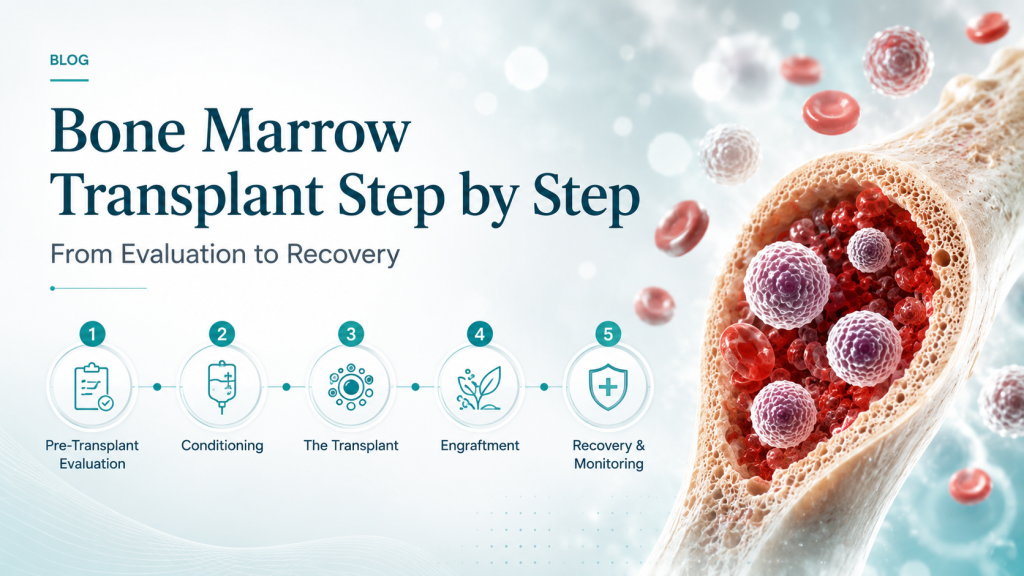
The transplant process unfolds over several weeks and can be broken into five distinct phases:
1. Pre-transplant evaluation: Medical workup for both patient and donor, as described above.
2. Conditioning: The patient receives high-dose chemotherapy, sometimes combined with radiation, to destroy the diseased marrow and suppress the immune system. This phase typically lasts 5–10 days.
3. The transplant: Healthy stem cells are infused through a central venous catheter—a process that looks similar to a blood transfusion and usually takes a few hours.
4. Engraftment: Over the following 2–4 weeks, the new stem cells migrate to the bone marrow and begin producing blood cells. This is a critical and closely monitored phase.
5. Recovery and monitoring: Once engraftment is confirmed, the patient enters a prolonged recovery period with regular follow-up appointments to monitor blood counts, organ function, and signs of complications.
Is a Bone Marrow Transplant Painful?
The transplant infusion itself is not painful. However, the conditioning phase—the high-dose chemotherapy that precedes it—can cause significant side effects, including nausea, fatigue, mouth sores, and hair loss. Patients are typically managed with antiemetics, pain relief, and nutritional support throughout this period.
During the engraftment phase, some patients experience a flu-like reaction as the immune system begins to rebuild. Medical teams monitor this closely and adjust supportive care as needed.
Bone Marrow Transplant Success Rate
Success rates vary considerably depending on the type of transplant, the underlying condition, the patient’s age, and whether the donor is a matched relative or an unrelated volunteer. As a general reference:
- Autologous transplants for conditions like multiple myeloma or lymphoma have five-year survival rates ranging from 50% to over 80%, depending on disease stage and patient age.
- Allogeneic transplants for acute leukaemia in remission carry five-year survival rates of approximately 40–65%.
- Matched sibling allogeneic transplants consistently yield better outcomes than unrelated donor transplants.
Iranian transplant centres report outcomes broadly consistent with international benchmarks, particularly for common indications such as thalassaemia and leukaemia, areas in which Iranian haematologists have decades of clinical experience.
Risks and Complications of Bone Marrow Transplant
A bone marrow transplant carries real risks, and patients must be fully informed before proceeding. Key complications include:
- Graft-versus-host disease (GvHD): The donor’s immune cells attack the recipient’s tissues. GvHD can be acute or chronic and ranges from mild to life-threatening.
- Infection: The immune system is severely suppressed during and after conditioning, making patients vulnerable to bacterial, viral, and fungal infections.
- Graft failure: The transplanted cells fail to engraft, requiring a second transplant.
- Organ damage: High-dose chemotherapy can affect the liver, kidneys, lungs, and heart.
- Relapse: The original disease may return, particularly in high-risk leukaemias.
Modern transplant centres manage these risks through prophylactic medications, strict infection control protocols, and regular monitoring.
Recovery After a Bone Marrow Transplant
Recovery is gradual and patient-specific. Most patients remain in hospital for 3–6 weeks post-transplant. After discharge, outpatient monitoring continues for at least 100 days—the period during which the risk of acute GvHD and serious infection is highest.
A rough timeline for international patients travelling to Iran:
| Phase | Approximate Duration |
|---|---|
| Pre-transplant evaluation | 1–2 weeks |
| Conditioning | 1–2 weeks |
| Transplant and engraftment | 2–4 weeks in hospital |
| Early recovery (outpatient) | 4–8 weeks in Iran |
| Long-term follow-up | Ongoing (can be managed at home) |
Patients are generally advised to plan for a stay of 2–3 months in Iran before returning home.
Why Consider a Bone Marrow Transplant in Iran?
Iran has a longer history in haematology and stem cell transplantation than many people expect. The country performed its first bone marrow transplant in 1991, and Iranian centres now carry out hundreds of procedures annually across a range of indications.
Cost: The cost of a bone marrow transplant in Iran is typically 60–80% lower than equivalent procedures in Europe, the United States, or Australia. Prices vary by transplant type and hospital, but patients can expect to pay in the range of $15,000–$40,000 USD for an allogeneic transplant—compared to $100,000–$300,000+ in many Western countries.
Medical expertise: Iranian haematologists are internationally trained and regularly publish in peer-reviewed journals. Hospitals such as Shariati Hospital (Tehran), Namazi Hospital (Shiraz), and Taleghani Hospital (Tehran) have dedicated bone marrow transplant units with modern facilities.
Infrastructure: Major transplant centres are equipped with laminar airflow rooms (essential for infection control post-transplant), advanced HLA typing laboratories, and experienced nursing teams.
Medical tourism support: Facilitated by agencies such as Medipars, international patients receive end-to-end coordination—from pre-arrival medical consultations and visa assistance to hospital admissions, translation services, and post-discharge follow-up. Patient stories, such as those shared by families who travelled to Iran from South Africa for organ transplantation, speak to the warmth, efficiency, and quality of care available.
Frequently Asked Questions
How much does a bone marrow transplant cost in Iran?
The cost depends on the transplant type and hospital. Autologous transplants generally cost less than allogeneic procedures. Most patients can expect to pay between $15,000 and $40,000 USD, a fraction of the equivalent cost in Western countries.
Which hospitals in Iran perform bone marrow transplants?
Leading centres include Shariati Hospital and Taleghani Hospital in Tehran, and Namazi Hospital in Shiraz. These facilities have dedicated haematology and BMT units staffed by experienced specialists.
How long do I need to stay in Iran for a bone marrow transplant?
Plan for a minimum of 2–3 months. This includes pre-transplant testing, the conditioning and transplant phases, and early outpatient recovery. Long-term follow-up can typically be managed in your home country.
Is Iran safe for international patients seeking medical treatment?
Thousands of international patients travel to Iran annually for medical care. Major hospitals in Tehran and Shiraz are equipped to receive foreign patients, and medical tourism agencies provide comprehensive support throughout the process.
Can I bring a family member as a donor to Iran?
Yes. Family members who are potential donors will need to undergo HLA typing and a medical evaluation in Iran before the transplant proceeds. Your medical tourism coordinator can advise on the specific requirements.
What is graft-versus-host disease, and how is it managed in Iran?
GvHD occurs when the donor’s immune cells attack the recipient’s body. Iranian transplant centres use standard international protocols for GvHD prophylaxis and treatment, including immunosuppressive medications and close monitoring.
How do I get started with a bone marrow transplant in Iran?
Begin by contacting a reputable medical tourism facilitator such as Medipars. They will review your medical records, connect you with the appropriate specialist, and provide a detailed treatment plan and cost estimate before you travel.
