
Scoliosis Surgery in Iran: Types, Risks, Price and Recovery Timelines
Scoliosis Surgery in Iran
Scoliosis surgery, most commonly spinal fusion, straightens and stabilises an abnormally curved spine using metal rods, screws, and bone grafts. Surgeons typically recommend it when a curve exceeds 45–50 degrees, continues progressing despite bracing, or threatens heart and lung function. Recovery usually takes three to six months before returning to normal activity.
A diagnosis of scoliosis can feel overwhelming, especially when a doctor starts using words like “fusion” or “instrumentation.” Most people picture a straightforward back problem, not a condition that might eventually call for major spinal surgery. Yet for a meaningful number of patients, particularly adolescents with progressive curves, surgery becomes the most effective way to prevent long-term complications.
This guide walks through what scoliosis surgery actually involves, who needs it, what recovery looks like, and the questions patients and parents ask most often before committing to the procedure. The goal isn’t to replace a conversation with an orthopaedic surgeon, but to help you walk into that conversation better informed.
What causes scoliosis, and why does it sometimes require surgery?
Scoliosis is a sideways curvature of the spine, often appearing as an “S” or “C” shape when viewed on an X-ray. Most cases are idiopathic, meaning there’s no identifiable single cause, though genetics appear to play a role. Scoliosis can also develop due to congenital spinal abnormalities, neuromuscular conditions such as cerebral palsy, or degeneration in older adults.
Not every curve needs surgical correction. Mild curves, generally under 25 degrees, are often simply monitored over time. Moderate curves between 25 and 40 degrees may be managed with a back brace, particularly in growing children where the goal is to prevent further progression. Surgery becomes the recommended path when curves grow more severe or when non-surgical options stop working.
When does a doctor recommend scoliosis surgery?
Surgeons generally consider surgery once a curve reaches roughly 45 to 50 degrees, since curves of this size tend to keep worsening even into adulthood. Several other factors influence the decision:
- Continued progression despite bracing. If a brace fails to slow the curve’s advance in a growing adolescent, surgery may be the next step.
- Pain that limits daily function. Adults with degenerative scoliosis sometimes develop nerve compression or chronic back pain severe enough to justify surgical intervention.
- Impact on breathing or heart function. Severe thoracic curves can compress the lungs and heart, making correction a medical necessity rather than a cosmetic choice.
- Visible deformity affecting quality of life. For some patients, the physical and psychological impact of a pronounced curve factors into the decision alongside the medical indicators.
Choose surgery if the curve is progressing rapidly or affecting organ function; choose continued observation or bracing if the curve is stable and mild. The right path depends heavily on age, curve location, and overall health, which is why this decision should always involve a specialist familiar with the patient’s full history.
What Happens During Scoliosis Surgery?
The most common procedure is spinal fusion. The surgeon places metal rods alongside the curved section of the spine, secured with screws or hooks attached to the vertebrae. Bone graft material is then packed between the vertebrae, encouraging them to grow together into a single, solid piece of bone over time. Once fused, that section of the spine no longer moves independently, which is what holds the correction in place permanently.
Surgery typically takes between four and eight hours, depending on how many vertebrae need fusing. Patients are placed under general anaesthesia, and surgeons monitor spinal cord function throughout the operation using neuromonitoring equipment to reduce the risk of nerve damage.
In some cases, particularly for younger children whose spines are still growing, surgeons use growing rods instead of a full fusion. These devices are lengthened periodically as the child grows, delaying permanent fusion until the spine is closer to mature.
Types of Scoliosis Surgery
Several surgical approaches exist for scoliosis, and the right choice depends on the patient’s age, curve severity, and whether the spine is still growing. Here are the main types:
- Spinal fusion permanently joins the affected vertebrae using metal rods, screws, and bone graft. It is the standard choice for adolescents and adults with large, fixed curves.
- Growing rods are used for younger children whose spines haven’t finished developing. These adjustable devices are implanted and periodically lengthened to keep pace with growth, postponing full fusion until the spine is more mature.
- Vertebral body tethering (VBT) is a newer, less invasive option that uses a flexible cord anchored to the vertebrae to gradually guide the spine into a straighter position while preserving motion. It tends to suit younger patients with moderate curves and significant growth remaining.
- Anterior release or hemivertebra resection are less common procedures used to address specific structural problems, particularly in congenital scoliosis where abnormally shaped vertebrae are the root cause.
Your surgeon will recommend the most appropriate technique based on a full review of your imaging, age, and overall spine health.
Scoliosis Surgery in Iran: Cost, Surgical Options, and What International Patients Should Expect
Iran has established itself as a credible destination for scoliosis surgery in Iran for international patients, with experienced spine teams operating across major cities including Tehran and Mashhad. Patients researching affordable scoliosis surgery abroad often find Iran’s combination of qualified spinal deformity surgeons and competitive treatment costs a compelling option. As with any scoliosis program, the choice of procedure isn’t one-size-fits-all — surgeons evaluate each patient individually, weighing factors like age, Cobb angle, how flexible the curve is, overall spinal balance, neurological symptoms, and how much growth potential remains. Getting those details right from the start is what determines which surgical approach will deliver the safest, most effective outcome for each patient.
Iranian spine centers offer a broad range of surgical options for scoliosis in Iran, from the widely performed posterior spinal fusion to newer techniques like vertebral body tethering (VBT) and growing rods for younger patients. Patients looking for the best hospitals for scoliosis surgery in Iran will find that not every procedure is available at every facility, and access to more specialized approaches depends on the hospital, the individual surgeon’s training, and whether the patient’s curve pattern and overall health make them a suitable candidate for scoliosis surgery abroad. For international patients researching specialist scoliosis surgeons in Iran or trying to understand which treatment path fits their case, understanding which options are realistically on the table — and asking the right questions before committing — can make a significant difference in the outcome you achieve.
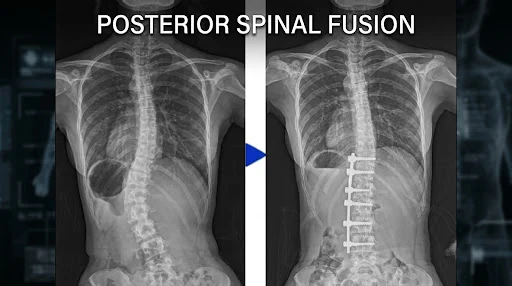
Posterior spinal fusion with instrumentation is the most established and widely performed approach in Iran. Surgeons access the spine from the back, attach metal rods using screws, and use bone graft to permanently fuse the affected vertebrae. It’s the go-to option for adolescents and adults with larger, more rigid curves that have progressed beyond the point where bracing can help.
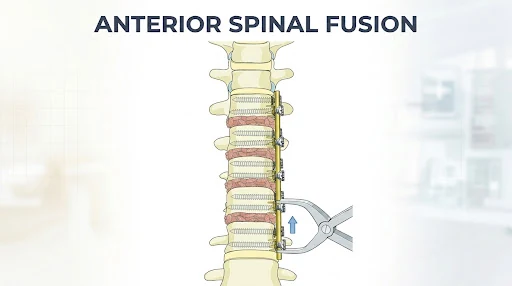
Anterior spinal fusion approaches the spine from the front — through the chest or abdomen, depending on where the curve sits. It’s used for specific curve patterns, particularly in the lower spine, and is sometimes combined with a posterior procedure to achieve better correction.
Vertebral body tethering (VBT) is a newer, motion-preserving option that attaches a flexible cord along the outer side of the curve. As the child continues to grow, the tether gradually guides the spine straighter — without permanently fusing it. It tends to work best for younger patients with moderate, flexible curves and significant growth remaining.
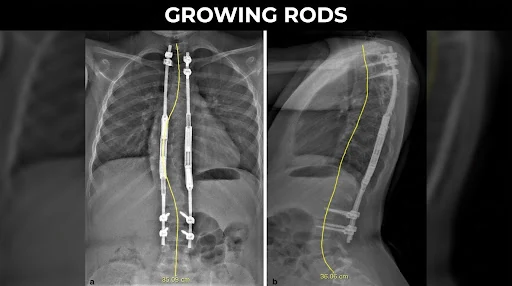
Growing rods are designed for young children whose scoliosis is severe enough to need treatment but whose spines are still far from mature. Adjustable rods are implanted and lengthened periodically to keep pace with the child’s growth, holding the curve in check until a definitive fusion becomes appropriate.
Complex deformity correction and osteotomy is reserved for severe, rigid, or structurally unusual curves — including many congenital cases. It may involve cutting and reshaping sections of bone to restore proper spinal alignment. These procedures require advanced surgical planning, experienced teams, and careful neurological monitoring throughout.
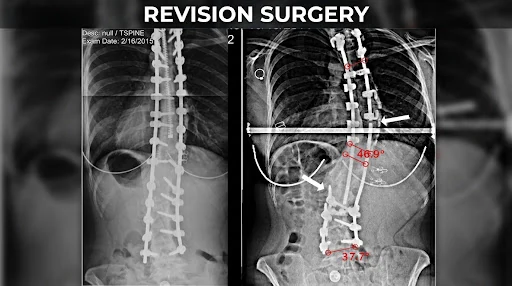
Revision scoliosis surgery addresses problems that develop after a previous spinal operation, such as hardware loosening, failed fusion, or new curve progression above or below an existing fusion. It is generally more complex than a first-time procedure and calls for a team with specific experience in managing these cases.
Published clinical data from Iranian spine centers is still growing, but what exists is genuinely encouraging. For patients researching scoliosis surgery success rates in Iran, studies out of Tehran and Mashhad report meaningful curve correction and improved quality-of-life scores following posterior spinal fusion — with outcomes that compare favorably to those seen at established programs internationally. That said, the available data sets are relatively small, and most published evidence on spinal fusion outcomes in Iran focuses specifically on posterior screw-and-rod correction rather than the full spectrum of procedures available. This doesn’t mean other techniques aren’t being performed successfully in Iran; it simply means patients seeking long-term results of scoliosis surgery in Iran should ask their surgical team directly about their experience with the specific procedure being recommended and interpret any published figures as a helpful indicator rather than a guarantee.
One study from Tehran’s Imam Khomeini Hospital Complex — one of the leading centers for spinal fusion surgery in Tehran — looked at a small group of patients with Lenke type 1 idiopathic scoliosis who underwent posterior spinal fusion with pedicle screws between 2018 and 2021. Despite the modest sample size, the results were encouraging — patients showed significant improvement in both curve magnitude and SRS-22 quality-of-life scores after surgery, and outcomes were broadly comparable between male and female patients. While the study’s size limits how far these findings can be generalized, it offers meaningful, real-world evidence that adolescent scoliosis treatment in Iran, when performed at a leading Tehran center, can deliver genuine clinical benefit for international patients seeking scoliosis correction abroad.
A second study, this one tracking long-term outcomes from Mashhad, adds further weight to the picture for patients researching scoliosis surgery recovery time in Iran. Researchers followed adolescent patients with both idiopathic and congenital scoliosis for an average of seven to eight and a half years after posterior spinal fusion with pedicle screws and rods — making it one of the more detailed looks at long-term results of spinal fusion surgery in Iran available in the published literature. Both groups reported favorable results across pain levels, physical function, and overall satisfaction — but patients with idiopathic scoliosis consistently scored higher on quality-of-life measures, particularly in areas related to self-image and mental health. It’s a meaningful finding for anyone weighing the long-term benefits of scoliosis correction in Iran: not only does surgery hold up well over time, but for many patients the improvements extend well beyond physical correction.
For patients considering scoliosis surgery in Iran, the results are generally encouraging across the board. Most people can expect meaningful correction of the spinal curve, better overall spinal balance, and a noticeable reduction in visible deformity — improvements that often carry a real boost to self-confidence and daily comfort. Pain may also improve, though this isn’t guaranteed for every patient, and mobility is generally preserved to a reasonable degree depending on how much of the spine is fused. For international patients researching scoliosis surgery recovery time in Iran, quality of life tends to improve significantly once recovery is complete, and the fused segments reliably prevent the curve from progressing further in that area. That said, what any individual patient can realistically expect from scoliosis correction surgery in Iran depends on a mix of factors: how flexible and severe the curve is, the patient’s age at the time of surgery, and which surgical technique is used. Patients asking about long-term outcomes of spinal fusion surgery in Iran should also keep in mind that the goal of scoliosis surgery isn’t a perfectly straight spine — it’s safe, well-balanced alignment that supports long-term health and function.
Estimated prices by type of scoliosis surgery in Iran
| Type of surgery | Estimated price (USD) |
|---|---|
| Posterior spinal fusion with rods and screws | $8,000–15,000 |
| Anterior spinal fusion | $8,000–14,000 |
| Minimally invasive scoliosis correction | $9,000–16,000 |
| Vertebral Body Tethering (VBT) | $10,000–18,000 |
| Growing rods surgery (pediatric) | $9,000–16,000 |
| Revision scoliosis surgery | $15,000–25,000+ |
| Complex / severe scoliosis correction | $15,000–30,000+ |
| Surgical category | Package price |
|---|---|
| Standard scoliosis surgery | From $12,500 |
| Advanced scoliosis surgery | From $15,500 |
| Severe/complex scoliosis | From $19,500 |
| Revision scoliosis surgery | From $22,000 |
What’s Included in Your Scoliosis Surgery Package in Iran?
- Spine surgeon consultation
- Preoperative X-rays, MRI and CT scans
- Anesthesia and operating room
- Surgical implants (rods, screws, connectors)
- Hospital admission (usually around 5–10 days, depending on complexity)
- ICU, if medically required
- postoperative care
- Follow-up consultation
- Accommodation, visa, English interpreter (for medical visits only)
Recommended doctors and hospitals for scoliosis surgery in Iran
Iran has several university-affiliated spine surgery teams and specialist hospitals. For international patients, the following doctors and centres are worth considering based on their documented spine surgery qualifications, academic affiliations and published experience with spinal deformity correction.
A. Recommended spine surgeons
1. Dr. Babak Mirzashahi
Orthopedic surgeon and spine surgery subspecialist.
- Associate Professor, Tehran University of Medical Sciences.
- Fellowship training in spinal deformity.
- Member of AO Spine International and the North American Spine Society (NASS).
- Published research on surgical correction of idiopathic and severe rigid scoliosis.
- Strong documented scoliosis experience.
- Associated with Imam Khomeini Hospital Complex and Atieh Gharb Hospital.
2. Dr. Mohammad Zarei
Orthopedic surgeon and spine surgery subspecialist.
- Member of the spine surgery team at Imam Khomeini Hospital Complex.
- Academic affiliation with Tehran University of Medical Sciences.
- Co-author of research on posterior surgical correction and fusion for idiopathic scoliosis.
3. Dr. Saeedreza Mehrpour
Spine surgeon and academic affiliated with Tehran University of Medical Sciences.
- Published research on severe scoliosis correction.
- Clinical and research association with Shariati Hospital.
- Experience reported in research involving posterior-only correction and fusion.
4. Dr. Mohammad Hossein Nabian
Associate Professor of Pediatric Orthopedic Surgery.
- Academic affiliation with Tehran University of Medical Sciences.
- Clinical focus includes pediatric orthopedic deformities and spinal deformity.
- Relevant for children and adolescents requiring specialist scoliosis assessment.
- Associated with Shariati Hospital and Children’s Medical Center.
5. Dr. Mohammadhossein Jamaladini
Orthopedic surgeon and spinal deformity subspecialist.
- Professor at Yazd University of Medical Sciences.
- Reported involvement in establishing a spinal deformity treatment programme.
- Supervises a scoliosis and kyphosis correction surgery team at Shahid Rahnemoun Hospital, Yazd.
Spine surgeon and spinal deformity subspecialist.
- Neurosurgeon specializing in spinal deformity correction, including scoliosis and kyphosis.
- Associated with Treata Hospital, Tehran.
- Clinical experience in posterior spinal fusion with instrumentation for adolescent and adult patients.
- Skilled in managing moderate to severe spinal curves, including complex deformity cases.
- Relevant for patients seeking specialist assessment and surgical correction of progressive scoliosis.
B. Recommended hospitals and specialist centres
1. Yas Hospital – Tehran
Particularly relevant for spine care
- Dedicated multidisciplinary Spine Center.
- Orthopedic and neurosurgical spine specialists.
- Surgical, minimally invasive and non-surgical treatment options.
- Physiotherapy and rehabilitation services.
- International patient services, including pre-arrival consultation and VIP rooms.
2. Imam Khomeini Hospital Complex – Tehran
- University-affiliated academic medical centre.
- Spine surgery department with academic and clinical experience in scoliosis correction.
- Published research involving posterior spinal fusion and correction of severe rigid scoliosis.
- Suitable for evaluation of complex spinal deformities.
This hospital has particularly relevant published clinical research in scoliosis surgery.
3. Shafa Yahyaian Hospital – Tehran
- Specialist orthopedic hospital.
- Spine surgery department.
- Orthopedic surgery and rehabilitation services.
- Relevant for patients requiring specialist orthopedic assessment.
4. Shariati Hospital – Tehran
- Teaching hospital affiliated with Tehran University of Medical Sciences.
- Academic experience in pediatric orthopedic conditions and spinal deformities.
- Published research on severe scoliosis correction involving its medical faculty.
5. Nikan Hospital – Tehran
- Private hospital with a dedicated orthopedic and spine surgery department.
- Experienced spine surgery team with expertise in spinal deformity correction.
- Full diagnostic and imaging services, including preoperative MRI and CT scanning.
- Postoperative rehabilitation and physiotherapy support available on-site.
- International patient services, including coordination support for medical travel.
6. Treata Hospital – Tehran
- Private hospital offering specialist orthopedic and spine surgery services.
- Spine surgery team with experience in scoliosis and spinal deformity correction.
- Full diagnostic imaging available on-site, including MRI, CT, and X-ray.
- Postoperative care and physiotherapy rehabilitation support.
- International patient coordination services available for medical travelers.
Scoliosis Surgery Recovery Time in Iran: What International Patients Can Expect
For patients undergoing scoliosis surgery in Iran, hospital stays after spinal fusion typically last three to five days — sometimes slightly longer for international patients who require additional monitoring before they’re ready to travel. Iranian spine centers, particularly in Tehran, follow post-operative protocols in line with international standards: most patients are encouraged to stand and walk within a day or two of surgery, which helps reduce the risk of complications like blood clots and supports early healing.
Full recovery from scoliosis surgery in Iran follows a structured timeline, and most international patients find the process well-supported by Iranian spine centers. Here’s what to expect at each stage:
- Two to four weeks after scoliosis surgery in Iran, most international patients are able to return to light daily activities such as desk work or remote schooling — provided travel home has been cleared by their surgical team.
- Three to six months before resuming most normal physical activities; Iranian spine centers typically provide a structured rehabilitation plan to support this phase, whether patients are recovering locally or back home.
- Up to a year for the spinal fusion to fully mature and for patients to safely return to higher-impact sports or strenuous activity, in line with guidance from their Iranian spine surgeon.
In Iran, pain following scoliosis surgery is typically managed through a structured medication protocol in the first few weeks, with dosages adjusted as healing progresses. Iranian spine centers — particularly those in Tehran that regularly treat international patients — generally integrate physiotherapy into the recovery plan from an early stage, supporting a gradual return to strength and mobility. Rehabilitation may begin during the hospital stay itself, with guided movement exercises introduced before discharge. Most patients, whether recovering in Iran or continuing rehabilitation at home, describe a noticeable improvement in posture and a meaningful reduction in pain once the initial recovery period passes. International patients are usually provided with a written rehabilitation plan and can continue follow-up with their Iranian surgical team remotely after returning home.
What are the risks of scoliosis surgery?
As with any major operation, scoliosis surgery carries risks. These include infection, excessive bleeding, and reactions to anaesthesia. More specific to spinal fusion, there’s a small risk of nerve or spinal cord injury, which is why neuromonitoring is standard practice during the procedure. Hardware complications, such as rod or screw loosening, can occur and may occasionally require follow-up surgery. Pseudarthrosis, where the bone fails to fuse properly, is another possible complication, though it’s relatively uncommon with modern surgical techniques.
Choose a surgeon with specific experience in spinal deformity correction if you’re weighing where to have the procedure done, since outcomes and complication rates can vary meaningfully with surgical volume and expertise.
Is scoliosis surgery worth it?
For patients with severe or rapidly progressing curves, surgery often prevents far more serious problems down the line, including chronic pain, reduced lung capacity, and worsening deformity. Many patients report significant improvement in both physical comfort and confidence after recovery.
That said, surgery isn’t the right choice for everyone. Patients with mild, stable curves may never need it, and the decision should always weigh the specific curve pattern, age, overall health, and personal priorities. A second opinion from a spine specialist is a reasonable step before committing to major surgery, particularly for borderline cases.
Taking the next step
Scoliosis surgery is a significant decision, but it’s also a well-established procedure with decades of refinement behind it. If you or your child has been told surgery might be necessary, the most useful next step is a detailed conversation with an orthopaedic spine surgeon who can review imaging, explain the specific surgical plan, and set realistic expectations for recovery. Bring a list of questions, ask about the surgeon’s experience with similar curve patterns, and don’t hesitate to seek a second opinion if anything feels unclear.
Frequently asked questions
Costs vary widely depending on the country, hospital, complexity of the curve, and insurance coverage. Patients should request a detailed cost breakdown from their surgical team and check with their insurance provider about coverage specifics before proceeding.
Pain is expected in the days and weeks following surgery, but it’s managed with medication and typically decreases steadily. Most patients report that pain from the surgery itself resolves faster than the pain some had experienced from a severe curve beforehand.
Once a section of the spine is fused, that area won’t curve again. However, curves can sometimes develop or progress in sections of the spine above or below the fusion, particularly in adults, which is why long-term follow-up is recommended.
Bracing, physical therapy, and observation are common alternatives for mild to moderate curves. These approaches aim to slow or halt progression rather than correct an existing curve, so they’re generally not effective once a curve has become severe.
Good candidates typically include patients with curves above 45–50 degrees, those with curves that continue progressing despite bracing, and those experiencing pain or breathing difficulty linked to the curve. A spine specialist can assess individual suitability based on imaging and overall health.
Resources
The following sources offer reliable, in-depth information for patients and families researching scoliosis surgery, recovery, and treatment options. The Scoliosis Research Society (srs.org) publishes patient education materials covering surgical indications, procedure types, and long-term outcomes. The American Academy of Orthopaedic Surgeons (orthoinfo.aaos.org) provides clear overviews of spinal fusion, risks, and what to expect during recovery. For clinically reviewed articles on spinal deformity and surgical techniques, Spine-health (spine-health.com) is a practical resource written with patients in mind. The National Institute of Arthritis and Musculoskeletal and Skin Diseases (niams.nih.gov) also offers evidence-based guidance on scoliosis diagnosis and management. For peer-reviewed research, PubMed (pubmed.ncbi.nlm.nih.gov) provides access to published studies, including those referenced throughout this guide, allowing patients to review clinical evidence directly before consulting their surgical team.
Written by: Medipars Medical Content Team.
Reviewed by: Dr. H. Noori, Spine Surgeon and Spinal Deformity Subspecialist.
Last medically reviewed: November 10, 2026.
What Our Patients Say
While coming iran little nervous, because I don't know how thing's to be gone,but after arriving iran all arrangements are very good accommodation,food hospital,all hospital body test done so smoothly.
Not feel alone on this trip thanks to all people Monika ma'am,Tanus,saed all are good people I meet.
In hospital surgery day due to pain mix imotions because of pain but day by day how pain relieve is unthinkable and within 3day feel like nothing changes in my body and I am same as before.It's beautiful country and big heart lovely people in Iran and all I meet this trip Thankyou everyone will remember forever.
I share my this experience with people's and motivate them to come to Iran for medical treatment.
Thank you 🤝🙏🏻
Dear Dr.Yousef Ataipour, & team…
I want to express my heartfelt gratitude for the exceptional care and treatment you provided during my recent surgery…Your professionalism, compassion, and dedication to your patients are truly inspiring. Thank you for taking the time to listen to my concerns and for providing me with the best possible care. I'm grateful for your expertise and kindness… thank you so very much…
TO,
HASHEMINEJAD HOSPITAL TEHRAN Team,I'm writing to express my sincere appreciation for the outstanding care and hospitality I received during my recent stay at your hospital. From the moment I arrived, I was treated with kindness, respect, and compassion. The staff were attentive, responsive and went above and beyond to ensure comfort and well-being…Please know that your hard work and dedication do not go unnoticed….
Thank you again for everything.
The care and hospitality we received at HASHEMINE HOSPITAL TEHRAN was truly exceptional. The doctors, nurses, and staff were all incredibly kind, compassionate, and professional. They took the time to listen to our concerns, answered all our questions and provided us with the best possible care. I'm grateful for their expertise, dedication, and kindness. The hospital's commitment to patient care is evident in every aspect of their service.
Thank you so much for the great care and surgery you performed on my brother.. I wud like to thank all the doctors n his team n all the hospital staff especially the nurses,who have made such a huge difference for him…he is feeling much better and I appreciate all the efforts n support…
Hasheminejad hospital Tehran
Thanks to Monika n Aamir for all the hospitality n being so supportive in every aspect…thanks again we will come back n visit this beautiful city n explore it again…my special thanks to Thanush n sayid for being so kind n supportive…they made things easier for us…pls do keep in touch and we will keep u posted about Arun n his health… we thoroughly enjoyed our stay n are happily going back….forgot to mention this beautiful apartment we stayed at it made us feel at home…thank you 🙏
I was afraid when I came to a surgery like this.but wheni saw the Hospital formality, it was make a confidence for me. And now I finished my all jobs and i am going to back to back my home. This hospital and all off the teams are very well.
Thanks to all your team specially Monica to have patience with us. Keep it up for this noble job.
Each one of have helped us throughout our stay here.Keep the good work going. God bless you all.
The people around me did a very good job of keeping us comfortable all the time. They were available 24/7 . The hospital staff also did a great job. Our only concern was not knowing This place is good for medical tourism.
The journey to health
Everything was so well planned and went really smoothly. The medical leader( translator) was such a big help . He helped with everything and took care of everything very well. The hospital was so clean and every one of the staff was so well mannered and so kind. The Tehran city and all Iran is very clean and very neat .so enjoyable.
Amazing
The treatment with the help of all the surgeons doctors nurses and other support staff was really great and the people are very warm and willingness to help always
Wonderful experience
Yeah its really good experience. Good respecting peoples with cute smile faces. Well trained staffs and good facilities are there really great experience in my view
The people are very friendly,respecting and helpful.what thay promised thay did it and thay made our trip very enjoyable and unforgatable.
