
Colon Cancer Diagnosis: What Tests Are Needed and What Do the Results Mean?
Learn which tests diagnose colon cancer, where they're done, and what your results mean at each stage—explained in clear, patient-friendly language.
Colon cancer is diagnosed through a combination of tests, including a colonoscopy with biopsy, blood tests such as CEA, imaging scans like CT and MRI, and laboratory analysis of tissue samples. Together, these tests confirm whether cancer is present and determine its stage, from Stage 0 (very early) to Stage IV (advanced), which guides your treatment plan.
Receiving a colon cancer diagnosis—or being told you need tests to rule it out—can feel overwhelming. You may be facing a series of appointments, unfamiliar medical terms, and results you’re not sure how to interpret. Understanding what each test does and what the results mean can help you feel more in control during a stressful time.
This guide walks you through the key tests used to diagnose colon cancer, explains where each one is carried out, and describes what the results tell your medical team. We’ll also break down the different stages of colon cancer and explain what the findings at each stage mean for you.
Whether you’re preparing for your first appointment or trying to make sense of results you’ve already received, this article aims to give you clear, practical information in plain language.
Why Are Diagnostic Tests Needed for Colon Cancer?
Colon cancer often develops slowly, sometimes over several years, starting as small growths called polyps in the lining of the colon or rectum. Many people have few or no symptoms in the early stages, which is why testing plays such an important role.
Diagnostic tests serve three main purposes:
- Confirming a diagnosis — proving whether cancer is actually present.
- Determining the stage — finding out how large the cancer is and whether it has spread.
- Guiding treatment — helping doctors choose the most effective approach for your situation.
No single test can do all of this. Instead, your medical team combines results from several tests to build a complete picture.
What Tests Are Used to Diagnose Colon Cancer?
Below are the main tests used to diagnose colon cancer, along with the type of laboratory or department that typically carries out each one.
Colonoscopy (Endoscopy Department)
A colonoscopy is the gold-standard test for diagnosing colon cancer. A specialist called a gastroenterologist inserts a thin, flexible tube with a camera on the end (a colonoscope) into the rectum to examine the entire length of the colon.
During the procedure, the doctor looks for polyps, tumours, or areas of abnormal tissue. If anything suspicious is found, small tissue samples (biopsies) can be taken at the same time, or polyps can be removed. A colonoscopy is usually carried out in a hospital’s endoscopy department.
What the results mean: A clear colonoscopy means no visible signs of cancer or polyps. If abnormal tissue is found, it will be sent to a laboratory for further analysis before a diagnosis is confirmed.
Biopsy and Histopathology (Pathology Laboratory)
A biopsy is the removal of a small tissue sample so it can be examined under a microscope. The samples taken during a colonoscopy are sent to a pathology laboratory, where a specialist called a histopathologist studies them.
This is the only test that can definitively confirm whether cancer is present. The pathologist looks at the cells to determine whether they are cancerous, and if so, how aggressive they appear.
What the results mean: The report will state whether the cells are benign (non-cancerous) or malignant (cancerous). If cancer is found, the report also describes the tumour “grade,” which indicates how quickly the cancer is likely to grow.
Blood Tests, Including CEA (Clinical Biochemistry Laboratory)
Blood tests cannot diagnose colon cancer on their own, but they provide useful supporting information. Samples are analysed in a clinical biochemistry or haematology laboratory.
Common blood tests include:
- Full blood count (FBC) — checks for anaemia, which can be a sign of bleeding from a tumour.
- Liver function tests — help reveal whether cancer may have spread to the liver.
- Carcinoembryonic antigen (CEA) — a tumour marker that can be raised in people with colon cancer.
What the results mean: A raised CEA level may support a diagnosis and is often used to monitor how well treatment is working. However, CEA can be raised for other reasons, so it is never used alone to diagnose cancer.
CT Scan (Radiology Department)
A computed tomography (CT) scan uses X-rays to create detailed cross-sectional images of the body. It is usually carried out in a hospital’s radiology or imaging department.
For colon cancer, a CT scan of the chest, abdomen, and pelvis helps doctors see whether the cancer has spread to nearby lymph nodes or distant organs such as the liver or lungs.
What the results mean: The scan helps determine the extent of the disease, which is essential for staging. It can reveal whether the cancer is contained within the colon or has spread beyond it.
MRI Scan (Radiology Department)
Magnetic resonance imaging (MRI) uses strong magnetic fields and radio waves to produce detailed images of soft tissues. It is particularly useful for rectal cancer, as it shows precisely how deeply a tumour has grown into the bowel wall and surrounding tissue.
What the results mean: An MRI helps plan surgery and radiotherapy, especially for cancers in the rectum. It gives a clearer view of soft tissue than a CT scan.
PET Scan (Nuclear Medicine Department)
A positron emission tomography (PET) scan uses a small amount of radioactive sugar to highlight areas of high cellular activity, which can indicate cancer. It is carried out in a nuclear medicine department.
What the results mean: A PET scan can detect cancer that has spread to other parts of the body, sometimes revealing sites that other scans miss. It is often combined with a CT scan (PET-CT) for greater accuracy.
Molecular and Genetic Testing (Molecular Pathology Laboratory)
Once cancer is confirmed, tissue samples may undergo molecular testing in a specialised molecular pathology laboratory. These tests look for specific genetic changes in the tumour, such as KRAS, NRAS, and BRAF mutations, as well as microsatellite instability (MSI).
What the results mean: These results help doctors choose targeted therapies and predict how the cancer may respond to certain treatments. For example, some drugs only work in tumours without particular mutations.
What Are the Stages of Colon Cancer and What Do the Results Mean?
Staging describes how far the cancer has grown and spread. Doctors most commonly use the TNM system, which stands for Tumour (size and depth), Nodes (whether lymph nodes are affected), and Metastasis (whether the cancer has spread to distant organs). These findings are then grouped into numbered stages.
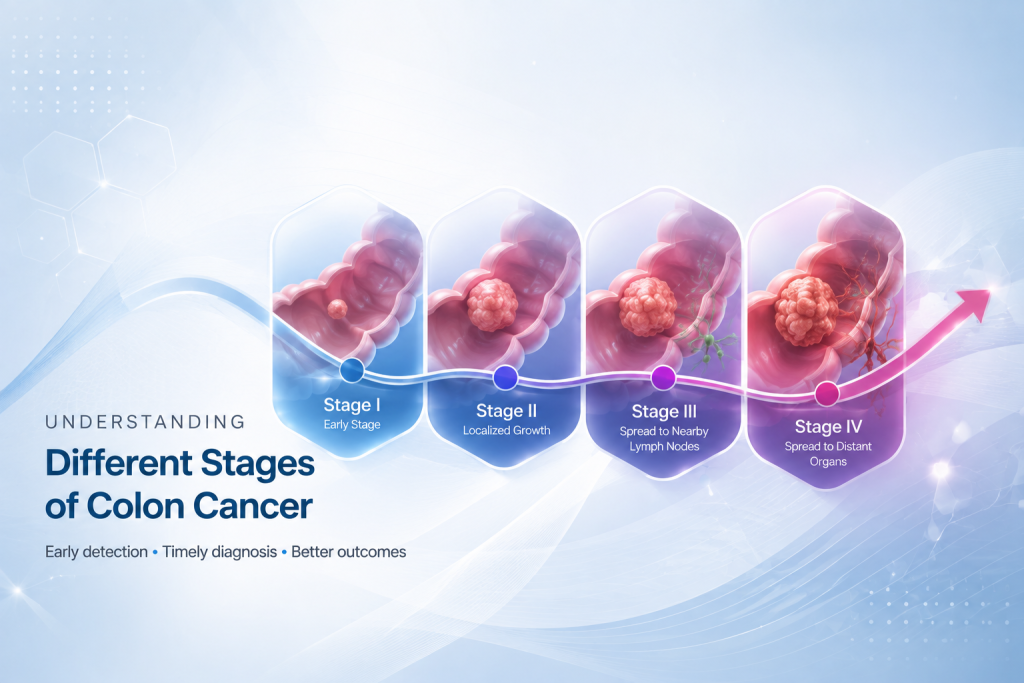
Here’s what the results at each stage mean.
Stage 0 (Carcinoma in Situ)
At this earliest stage, abnormal cells are found only in the innermost lining of the colon or rectum. They have not grown into deeper layers.
What it means for you: Stage 0 is highly treatable, often by removing the affected tissue during a colonoscopy or with minor surgery. The outlook is excellent.
Stage I
The cancer has grown into deeper layers of the colon wall but has not spread to nearby lymph nodes or distant sites.
What it means for you: Surgery to remove the affected section of the colon is usually the main treatment. The chances of a full recovery at this stage are very high.
Stage II
The cancer has grown through the wall of the colon and may have reached nearby tissue, but it has not spread to the lymph nodes.
What it means for you: Surgery remains the primary treatment. Some people may also be offered chemotherapy, depending on specific features of the tumour identified in laboratory testing.
Stage III
The cancer has spread to nearby lymph nodes but not to distant organs.
What it means for you: Treatment usually combines surgery with chemotherapy to reduce the risk of the cancer returning. Molecular testing results may influence which drugs are used.
Stage IV (Metastatic)
The cancer has spread to distant parts of the body, most commonly the liver or lungs.
What it means for you: Treatment focuses on controlling the cancer and managing symptoms. Options may include surgery, chemotherapy, targeted therapies, and other treatments guided by molecular test results. While Stage IV is more challenging, treatments continue to improve outcomes and quality of life.
Making Sense of Your Test Results
Test results can be difficult to interpret on your own, and a single figure or phrase rarely tells the whole story. Your medical team will look at all your results together—the colonoscopy findings, biopsy report, blood tests, scans, and any molecular testing—before confirming a diagnosis and stage.
If you don’t understand something in your report, ask your doctor or specialist nurse to explain it. There is no such thing as a silly question when it comes to your health. Writing down your questions before appointments and bringing someone with you can also help.
Taking the Next Step
A colon cancer diagnosis begins with a series of tests, each one adding a piece to the puzzle. From the colonoscopy that spots a suspicious growth, to the biopsy that confirms it, to the scans that reveal how far it has spread—every result helps your medical team build a plan tailored to you.
Understanding these tests and what their results mean can ease some of the anxiety that comes with the process. If you or a loved one is facing colon cancer, speak openly with your healthcare team, ask for clear explanations, and seek support from trusted resources. Early diagnosis and prompt treatment offer the best possible outcomes, so never hesitate to act on your symptoms or attend your screening appointments.
Frequently Asked Questions
How is colon cancer diagnosed?
Colon cancer is diagnosed through a combination of tests. A colonoscopy allows doctors to view the colon and take biopsies, which are then examined in a pathology laboratory to confirm whether cancer is present. Blood tests, CT scans, MRI scans, and sometimes PET scans help determine how far the cancer has spread.
What is the most accurate test for colon cancer?
A colonoscopy combined with a biopsy is the most accurate way to diagnose colon cancer. The colonoscopy allows doctors to see abnormal areas directly, while the biopsy provides tissue that a histopathologist examines under a microscope to confirm the diagnosis.
Can a blood test detect colon cancer?
Blood tests alone cannot diagnose colon cancer. Tests such as the CEA tumour marker and full blood count can provide supporting information and help monitor treatment, but a firm diagnosis requires a colonoscopy and biopsy.
What do the stages of colon cancer mean?
The stages describe how far the cancer has spread. Stage 0 means abnormal cells are confined to the colon lining, Stages I to III describe increasing growth and spread to nearby tissue or lymph nodes, and Stage IV means the cancer has reached distant organs such as the liver or lungs.
How long does it take to get colon cancer test results?
Timescales vary depending on the test. Colonoscopy findings may be discussed straight away, while biopsy and molecular testing results can take one to two weeks, as they require detailed laboratory analysis. Your medical team will let you know when to expect each result.
