
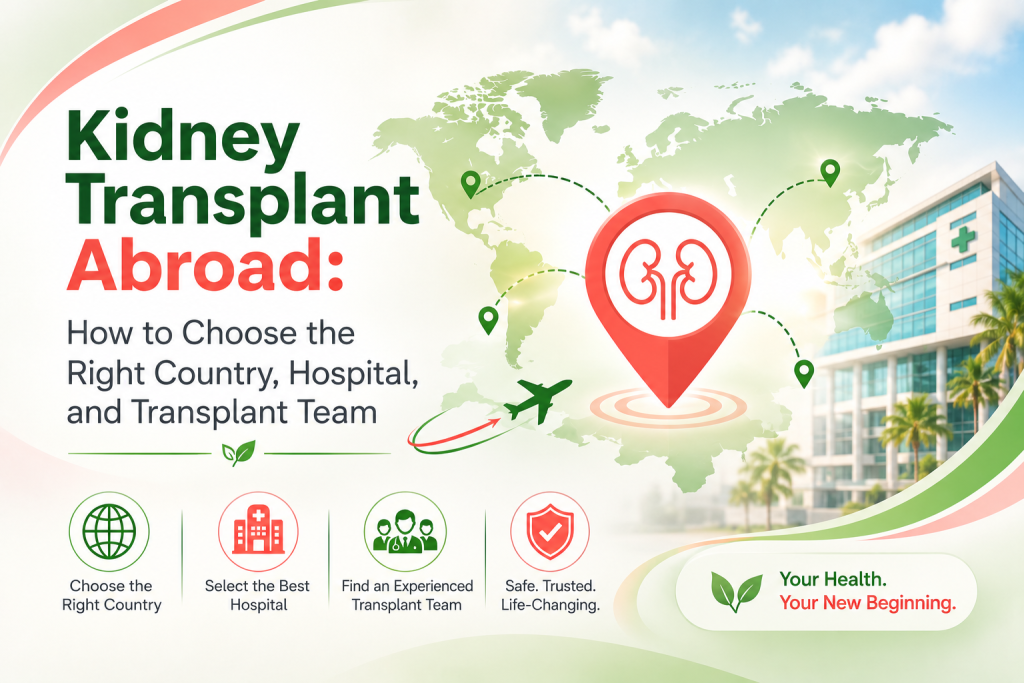
Choosing the right destination for a kidney transplant abroad requires evaluating legal frameworks, hospital accreditation, transplant team experience, post-operative care, and total cost. Iran stands out as a particularly strong option due to its government-regulated transplant programme, internationally trained surgeons, and significantly lower costs compared to Western countries.
Every year, thousands of patients with end-stage renal disease are told the same thing: the waiting list is too long, the costs are too high, or — as one family from South Africa discovered — the political situation has made it impossible. For many, going abroad for a kidney transplant is not a lifestyle choice. It is a lifeline.
But the decision carries real weight. This is major surgery in a foreign country, coordinated across language barriers, legal systems, and healthcare cultures. Getting it wrong does not just waste money — it puts lives at risk.
This guide walks you through every key criterion to evaluate before committing to a destination, and explains why Iran has become one of the most sought-after countries for kidney transplants among international patients.
What to look for when choosing a country for a kidney transplant
Does the country have a clear legal framework for living donor transplants?
The legality of living donor kidney transplants varies significantly between countries. Some nations prohibit foreigners from receiving donor organs entirely. Others permit it under strict conditions. Before anything else, confirm that the destination country explicitly allows international patients to undergo transplantation with a living donor — and verify this through official government health sources, not just clinic websites.
A country with a well-defined legal structure protects both patient and donor. It ensures that all parties are screened, consented, and protected throughout the process.
Is the hospital internationally accredited?
Accreditation from bodies such as the Joint Commission International (JCI) is a reliable marker of hospital quality. Accredited hospitals are assessed against global standards for patient safety, infection control, surgical protocols, and post-operative care.
That said, accreditation alone is not sufficient. Look for hospitals with dedicated transplant units — not general surgical wards that perform transplants occasionally. A centre performing a high volume of transplants each year will have refined its protocols, its complications management, and its aftercare pathways far beyond what a lower-volume centre can offer.
How experienced is the transplant team?
The transplant team is arguably the most important factor in outcomes. You need a nephrologist, transplant surgeon, anaesthesiologist, and immunologist working together — not a loosely connected group of specialists.
Ask how many kidney transplants the lead surgeon has performed. Ask about the hospital’s one-year and five-year graft survival rates. Ask what happens if complications arise — is there an ICU, a dialysis unit, and a dedicated transplant ward on site?
A confident, experienced team will answer these questions readily. Hesitation or vagueness is a warning sign.
What does the total cost include — and what does it not?
Medical tourism pricing is not always transparent. An initial quote may exclude pre-operative testing, immunosuppressant medication, hospital accommodation for a companion, post-operative consultations, or emergency care if complications arise.
Request an itemised breakdown. Understand what happens financially if the transplant date is delayed, or if the patient requires a longer stay than anticipated. The cheapest quote is rarely the safest starting point.
How strong is the post-operative support?
Recovery from a kidney transplant takes months. Even after returning home, patients require close monitoring of kidney function, immunosuppressant levels, and signs of rejection. The best international transplant programmes offer follow-up consultations via telemedicine and provide detailed medical records that can be shared with a local nephrologist.
Find out how the hospital communicates with patients after discharge. A programme that goes quiet once you board your return flight is not one to trust.
Is there a reputable medical facilitation agency involved?
Navigating a transplant abroad without local support is extremely difficult. A reputable medical tourism facilitator can coordinate hospital appointments, manage translation, handle logistics, and advocate for the patient when things do not go to plan.
Look for agencies with verifiable patient testimonials, transparent fee structures, and clear communication practices. An agency that responds quickly, is reachable outside office hours, and proactively provides information — rather than waiting to be asked — is a strong sign of professionalism.
Why Iran is a leading destination for kidney transplants abroad
Iran holds a unique position in global transplant medicine. It is the only country in the world with a government-regulated, legal framework for compensated living donor kidney transplantation. This system — established in 1988 — has virtually eliminated the waiting list for kidney transplants within Iran and has attracted growing interest from international patients seeking a legal, safe, and ethical route to transplantation.
Iran’s legal and regulatory framework
The Iranian government’s approach to kidney donation is governed by the Ministry of Health and Medical Education. Donors are screened rigorously, compensated through a structured national system, and protected by law. For international patients arriving with their own donor — a family member or altruistic donor from their home country — the process is equally well-regulated and clearly defined.
This legal clarity is one of the primary reasons patients from South Africa, Pakistan, the UAE, and across Europe choose Iran. There is no ambiguity about what is permitted, and the process is designed to move efficiently once all medical and legal requirements are met.
Hospital quality and surgical expertise
Iran has a long history of academic medicine. Hospitals such as Imam Khomeini Hospital Complex in Tehran and Ghaem Hospital in Mashhad have performed thousands of kidney transplants and are staffed by surgeons trained at leading international institutions. Iranian transplant nephrologists regularly publish in peer-reviewed journals and participate in international transplant congresses.
For patients concerned about surgical quality, Iran’s track record speaks clearly. Graft survival rates at leading Iranian centres are comparable to those reported by transplant programmes in Europe and North America.
Cost
The cost of a kidney transplant in Iran is substantially lower than in most Western countries — often a fraction of what patients would pay in the United Kingdom, Germany, or the United States — without compromising on clinical standards. This makes Iran particularly accessible for patients from lower- and middle-income countries who have exhausted domestic options.
The patient experience
Serah Khan, who brought her 16-year-old nephew to Iran for a kidney transplant after facing insurmountable barriers in South Africa, described the experience this way: “Within two weeks of being in Iran, a date was set for surgery as promised. The process was smooth and the aftercare was great.”
Her account reflects what many international patients report: a system that is efficient, compassionate, and genuinely oriented towards saving lives. The agency she worked with, Medipars, coordinated every aspect of the journey — from pre-operative logistics to after-hours availability for questions — demonstrating exactly the kind of support that makes international transplantation manageable for families under enormous stress.
Making the decision with confidence
Choosing a country, hospital, and transplant team for a kidney transplant abroad is one of the most consequential decisions a patient or their family will ever make. The criteria outlined here — legal clarity, hospital accreditation, team experience, transparent costs, post-operative support, and reliable facilitation — give you a structured framework for evaluating your options.
Iran meets each of these criteria at a high level. Its government-regulated system, experienced surgical teams, and well-established medical tourism infrastructure make it a genuinely compelling option — not by default, but on merit.
If you are considering a kidney transplant abroad, the first step is to seek a formal consultation with a transplant centre and a medical facilitator who can assess your specific situation. The right team will not pressure you. They will give you the information you need to decide with clarity and confidence.
Frequently asked questions
Is it legal to get a kidney transplant abroad?
Yes, in many countries — including Iran — it is entirely legal for international patients to receive a kidney transplant, provided the correct medical and legal protocols are followed. The key is to verify the legal framework of the destination country before proceeding.
How long does a kidney transplant abroad typically take?
The timeline varies depending on pre-operative testing, donor compatibility assessments, and scheduling. In Iran, patients with an identified donor often complete the full process — from arrival to surgery — within two to four weeks.
What happens if complications arise after returning home?
Reputable transplant programmes provide detailed medical records and, in many cases, telemedicine follow-up. Patients are also advised to establish a relationship with a local nephrologist before travelling, so that ongoing monitoring can continue seamlessly upon return.
How much does a kidney transplant cost in Iran compared to other countries?
Costs in Iran are significantly lower than in most Western countries. While exact figures depend on the hospital, the complexity of the case, and the length of stay, patients typically pay a fraction of what comparable treatment would cost in the United Kingdom, Germany, or the United States.
Do I need a medical tourism facilitator to arrange a kidney transplant in Iran?
It is strongly advisable. A reputable facilitator coordinates hospital appointments, manages translation, handles accommodation and logistics, and provides patient advocacy throughout the process. Attempting to arrange a transplant independently in a foreign country adds considerable risk and complexity.
