
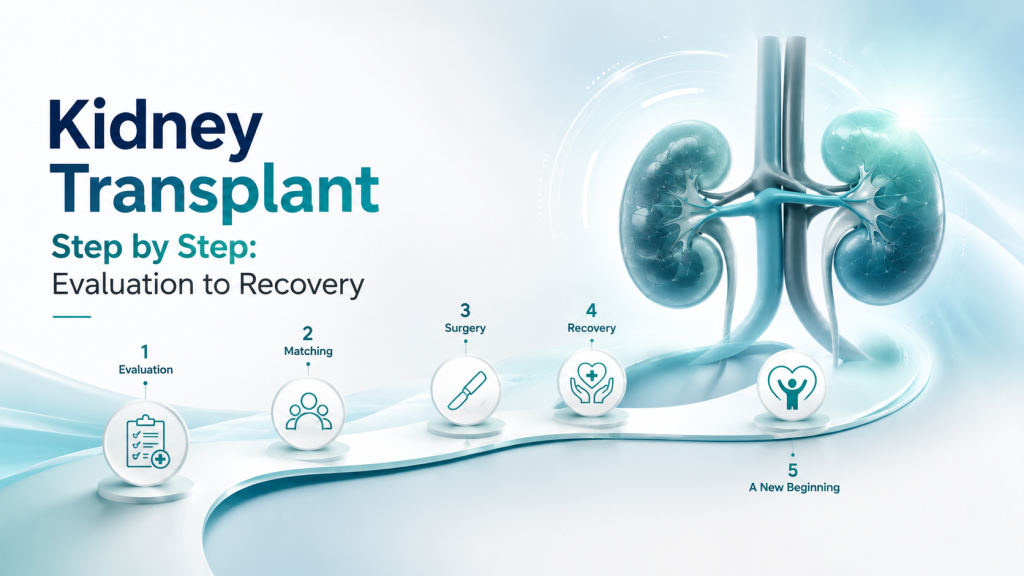
A kidney transplant involves three main stages: a medical evaluation (lasting several weeks), a waiting period for a suitable donor (which can range from months to years), and the surgery itself, followed by lifelong medication and follow-up care. The entire process requires close coordination between the patient, medical team, and—where applicable—a living donor.
Receiving a kidney transplant is one of the most significant medical journeys a person can undertake. For patients with end-stage kidney disease or chronic kidney failure, it often represents the clearest path to a longer, better quality of life. Yet the process is rarely straightforward, and many patients and families enter it with little idea of what to expect at each stage.
This guide walks you through each step—from your first evaluation to life after surgery—so you can approach the process with clarity and confidence.
Step 1: First Evaluation — What Should You Expect?
The transplant process begins with a comprehensive medical evaluation at a transplant centre. This is not a single appointment; it is typically a multi-day assessment spread over several weeks, conducted by a multidisciplinary team that includes nephrologists, transplant surgeons, cardiologists, dietitians, and social workers.
For international patients, this evaluation stage involves an additional layer of coordination. Medical teams will typically need to review prior records from the patient’s home country, including documentation of diagnosis, kidney disease progression, and any treatment received to date. Dialysis history must be verified, and transplant eligibility documents from the referring institution may be required. Alongside the standard workup, international patients can expect updated blood typing and HLA matching, comprehensive infectious disease screening relevant to their region of origin, cardiac clearance, and imaging studies to assess vascular anatomy. Where a living donor is involved — particularly in cases where the donor and recipient have travelled together — additional donor-recipient compatibility checks will be carried out as part of the pre-operative assessment. These checks are essential to confirm suitability before proceeding and, when the donor is pre-matched, can often be completed efficiently within a condensed timeline.
The purpose of the evaluation is to determine whether you are medically, psychologically, and socially ready for transplant. Doctors will review your full medical history, assess the severity of your kidney disease, and screen for any conditions that could complicate surgery or recovery.
What tests are required for a kidney transplant evaluation?
The required workup is extensive and applies to all patients, though international patients should expect additional steps. Alongside the standard tests, those travelling from abroad may need to provide verified medical records from their home country, documented dialysis history, and transplant eligibility documentation from their referring institution. Where a pre-matched living donor is involved, supplementary donor-recipient compatibility checks will also be carried out before surgery can proceed. All patients — domestic and international — should expect the following core tests:
- Blood tests: Full blood count, kidney and liver function tests, blood typing, and tissue typing (HLA matching) to assess compatibility with potential donors
- Urine tests: To assess residual kidney function
- Imaging: Ultrasound, CT scan, or MRI to evaluate the kidneys, bladder, and surrounding blood vessels
- Cardiac tests: Electrocardiogram (ECG), echocardiogram, and sometimes a stress test, particularly for older patients or those with a history of heart disease
- Cancer screening: Mammogram, colonoscopy, or other relevant screenings depending on age and risk factors
- Infectious disease screening: Tests for HIV, hepatitis B and C, cytomegalovirus (CMV), and tuberculosis — international patients may require expanded panels based on their region of origin
- Psychological evaluation: To assess your ability to manage post-transplant medications and lifestyle changes
- Crossmatch testing (international patients): A final crossmatch test — mixing the recipient’s blood with the donor’s — is carried out to confirm there is no immune reaction before surgery can proceed
- Donor-recipient compatibility review (international patients): Where a pre-matched living donor has travelled with the recipient, the transplant team will conduct a thorough review of all donor medical records and perform repeat compatibility checks on arrival to verify the match
- Travel-ready medical documentation (international patients): Verified copies of diagnosis history, kidney disease progression records, dialysis logs, and any transplant eligibility letters from the referring institution at home must be submitted before or upon arrival
- Repeat assessments on arrival (international patients): Some tests performed in the patient’s home country may need to be repeated at the transplant centre to meet local clinical standards and ensure results are current — particularly blood work, imaging, and infectious disease panels
If any issues are identified during evaluation—such as cardiovascular disease—these must be addressed before you can be listed for transplant. For international patients, this applies equally to any concerns arising from the review of prior medical records submitted from their home country, as well as any findings that emerge from repeat testing carried out locally at the transplant centre. Whether flagged through existing documentation or newly identified on arrival, such issues must be fully resolved before the team can proceed to surgery.
Getting on the Waiting List — How Long Is the Wait, and Is There a Faster Route?
Once your evaluation is complete and the transplant team has confirmed you are a suitable candidate, you are added to the national transplant waiting list. In the UK, this list is managed by NHS Blood and Transplant (NHSBT).
For international patients who have already identified a compatible living donor from their own country — someone of the same nationality — there is a significantly faster alternative: kidney transplantation in Iran. Iran operates a well-established, government-regulated transplant system that is experienced in treating patients from abroad. When a recipient arrives with a pre-matched living donor, no waiting list applies. The medical team can move directly through the remaining assessments and pre-operative preparations, and in many cases, the entire process — from initial evaluation to surgery — can be completed within just a few weeks. For patients who have a willing, compatible donor ready and want to avoid the lengthy delays of a deceased donor waiting list, this route offers a clear, efficient, and well-supported path to transplantation.
Waiting times vary significantly depending on your blood type, tissue type, and the availability of compatible deceased donors. On average, patients in the UK wait two to three years for a deceased donor kidney, though those with common blood types or highly sensitised immune systems may wait considerably longer. Patients with rare tissue types or high levels of pre-formed antibodies (measured via the Panel Reactive Antibody, or PRA, test) often face extended waits.
For international patients, a very different path exists. If you have already identified a compatible living donor from your own country — someone of the same nationality who has been assessed and confirmed as a match — travelling to Iran for the transplant can bypass the waiting list entirely. Iran runs a well-established, government-regulated transplant system with extensive experience in treating international patients. When a recipient arrives with a pre-matched living donor, the medical team can move swiftly through the remaining assessments and pre-operative preparations. In most cases, the entire process — from arrival and final evaluation through to surgery — can be completed within just a few weeks. There is no queue, no uncertainty about donor availability, and no years spent waiting. For patients who have a willing, compatible donor ready and are looking for a timely, structured route to transplantation, Iran offers one of the most efficient and accessible options available.
Patients on the national waiting list must remain contactable at all times. When a suitable deceased donor kidney becomes available, transplant teams have only hours to assess suitability and proceed — so being reachable day or night is essential. International patients pursuing a transplant in Iran with their own pre-matched living donor face none of this uncertainty. Because the donor is already identified and confirmed before travel, the procedure can be planned and scheduled in advance — much like any other elective surgery — with a clear timeline and no dependence on donor availability.
Finding a Donor: Living vs. Deceased Donor Transplants
There are two routes to receiving a donor kidney:
Living donor transplant: A kidney from a living donor—usually a family member, partner, or friend—is often the preferred option where possible. Living donor transplants can be planned in advance, reducing waiting time significantly. They also tend to produce better long-term outcomes, as the kidney is healthier and transplanted more quickly. In the UK, living donor transplants can sometimes be arranged within three to six months of the initial evaluation.
Deceased donor transplant: Kidneys from deceased donors are allocated according to compatibility and time spent on the waiting list. While waiting times are longer, this remains the most common route for transplantation.
Some patients may also explore international transplant programmes in countries such as Iran, which has a government-regulated living donor system and has helped a number of international patients receive transplants where domestic options were unavailable.
Step 2: The Surgery — How Is a Kidney Transplant Performed?
The transplant operation itself typically takes two to four hours and is performed under general anaesthetic.
Contrary to what many patients expect, the diseased kidneys are usually left in place unless they are causing specific problems such as infection or high blood pressure. The new kidney is placed in the lower abdomen (the pelvic area), where it is connected to the nearby blood vessels and bladder. This positioning allows for easier surgical access and better blood supply.
The surgical steps proceed as follows:
- An incision is made in the lower abdomen
- The donor kidney’s artery and vein are connected to the recipient’s iliac artery and vein
- The ureter (the tube that carries urine from the kidney to the bladder) is connected to the recipient’s bladder
- The incision is closed and the patient is moved to recovery
In many cases, the new kidney begins producing urine almost immediately on the operating table—a positive early sign. In others, particularly with deceased donor kidneys, there may be a period of “delayed graft function,” during which the patient requires temporary dialysis while the kidney settles.
Step 3: Recovery — What Happens After the Kidney Transplant Surgery?
Recovery begins in the hospital. Most patients spend one to two weeks as an inpatient following surgery. During this time, the transplant team monitors kidney function closely, watching for signs of rejection, infection, or surgical complications.
Immunosuppressant medications are started immediately after surgery. These drugs—which the patient will take for life—prevent the immune system from attacking the new kidney. Common medications include tacrolimus, mycophenolate, and prednisolone. Finding the right balance is critical: too little immunosuppression risks rejection; too much raises the risk of infection and certain cancers.
Common post-operative experiences include:
- Fatigue and discomfort around the incision site
- Frequent blood and urine tests in the first weeks
- Dietary adjustments, particularly around fluid intake, potassium, and salt
Most patients are able to return to light daily activities within four to six weeks, and many return to work within two to three months, depending on the nature of their role and how the recovery progresses.
Long-Term Care and Follow-Up After a Kidney Transplant
A successful transplant does not mean the end of medical involvement—it marks the beginning of a new, ongoing relationship with your transplant team. Follow-up appointments are frequent in the first year (sometimes weekly in the early months) and gradually reduce over time.
Long-term considerations include:
- Medication adherence: Missing doses of immunosuppressants significantly increases the risk of rejection
- Monitoring for rejection: Symptoms include reduced urine output, swelling, and tenderness over the transplant site
- Cardiovascular health: Patients with transplants carry a higher risk of heart disease; regular monitoring and a heart-healthy lifestyle are essential
- Kidney function monitoring: Regular blood tests track creatinine levels and overall graft function
- Cancer screening: Immunosuppression increases susceptibility to certain skin cancers and lymphomas, requiring vigilant screening
Transplanted kidneys do not last forever. The average lifespan of a deceased donor kidney is approximately 10 to 15 years, though many function well beyond this. Living donor kidneys tend to last longer. Some patients may eventually require a second transplant.
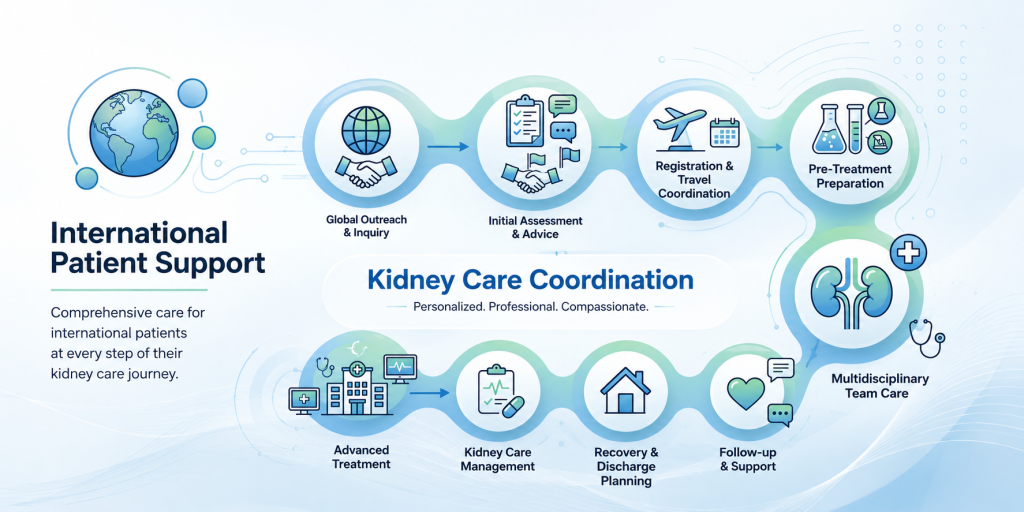
Planning Your Transplant Journey
A kidney transplant demands patience, preparation, and a strong support network. The process—from first evaluation through to long-term follow-up—spans months or years and involves dozens of medical professionals, tests, and decisions. Understanding each stage before you reach it makes the journey considerably less daunting.
If you or a loved one is at the start of this process, speak openly with your nephrologist about your options, timelines, and what to expect at each stage. Patients who engage actively with their medical team consistently report better outcomes and greater peace of mind.
Frequently Asked Questions
How long does the kidney transplant evaluation process take?
The evaluation process usually takes several weeks from start to finish. You will attend multiple appointments with different specialists — including a nephrologist, cardiologist, and psychologist — and undergo a range of tests before a decision is made. The exact timeline depends on how quickly your results come back and whether any health issues are identified that need to be treated before you can be approved for transplant. If you are an international patient arriving with a pre-matched living donor, some of this process can be streamlined, though key assessments will still need to be completed on arrival.
How Long Do Patients in Europe Usually Wait for a Kidney Transplant?
Waiting times vary across Europe depending on your country, blood type, and how sensitised your immune system is. For a deceased donor kidney, most patients wait between two and five years. If you have a common blood type and fewer pre-formed antibodies, your wait may be shorter. Highly sensitised patients, however, can face significantly longer delays. Opting for a living donor transplant — where a compatible donor is already identified — can reduce this to around three to six months, making it the fastest route for those who have a willing donor available.
Can a Living Donor Be Someone Outside the Patient’s Immediate Family?
Yes. A living donor does not have to be a blood relative. Depending on the country, donors can include a partner, close friend, or someone who wishes to donate altruistically to a stranger. Whoever the donor is, they must pass a full medical and psychological evaluation to confirm they are fit and healthy enough to donate safely. If a willing donor is not directly compatible with their intended recipient, paired or pooled donation programmes can sometimes find a way to make the transplant possible by matching donors and recipients across multiple pairs.
What Are the Main Risks of a Kidney Transplant?
Every surgical procedure carries some risk, and a kidney transplant is no exception. The most common concerns include surgical complications such as bleeding or infection, acute rejection in the weeks following surgery, and delayed graft function — where the new kidney takes time to start working properly. Long-term use of immunosuppressant medications also brings its own risks, including a higher chance of infections and a slightly increased likelihood of developing certain cancers over time. That said, most of these risks can be managed effectively with regular monitoring, routine blood tests, and strict adherence to your prescribed medications. Your transplant team will guide you through each of these risks in detail before you proceed, so you can make a fully informed decision.
What Is the Difference Between Acute and Chronic Rejection?
Acute rejection happens suddenly, usually within the first few weeks or months after your transplant. It can often be treated and reversed if caught early, which is why your team monitors you closely during this period. Chronic rejection, on the other hand, develops slowly over months or years, gradually reducing how well the transplanted kidney functions. It is harder to reverse and is one of the main reasons transplanted kidneys eventually stop working. Both types are detected through regular blood tests and, when needed, a kidney biopsy — small samples taken from the kidney to check for signs of damage. Staying consistent with your medications and attending all follow-up appointments is the best way to catch either type early.
**Can You Have a Second Kidney Transplant If the First One Fails?**Yes — a second or even third transplant is possible, and many patients go on to have one. If your first kidney transplant fails, you will go through the evaluation process again. Your team will pay particular attention to your antibody levels, which can rise after a first transplant and make finding a compatible donor more complex. This does not rule out a second transplant, but it does mean the matching process may take more time and care. Your transplant team will walk you through what this means for your individual situation and what options are available to you.
Can International Patients Get a Kidney Transplant in Iran Without Joining a Waiting List?
Yes. If you have already identified a compatible living donor from your own country — someone of the same nationality who has been medically assessed and confirmed as a match — you can travel to Iran for a transplant without joining any waiting list. Iran has a well-established, government-regulated transplant system with a strong track record of treating international patients. Because your donor is pre-matched and confirmed before you travel, the procedure can be planned and scheduled in advance, just like any other elective surgery. You will still need to complete a final round of assessments on arrival, but with a donor already in place, the team can move through these efficiently. In most cases, the full process — from arrival and pre-operative evaluation through to surgery — can be completed within a few weeks. For international patients with a willing and compatible donor ready, this is one of the fastest and most straightforward routes to transplantation available.
How Long Do Patients Wait for a Kidney Transplant in Iran?
If you are an international patient travelling to Iran with a pre-matched living donor of the same nationality, there is no waiting list. Iran’s government-regulated transplant system is experienced in handling pre-matched donor-recipient pairs, which means the medical team can move directly to final assessments and pre-operative preparations as soon as you arrive. Because your donor is confirmed before you travel, the process can be planned and scheduled in advance — much like any other elective procedure. In most cases, from arrival and final medical clearance through to surgery, the whole journey takes just a few weeks. For international patients who already have a willing and compatible donor ready, this is one of the fastest routes to transplantation available anywhere in the world.
This article was prepared by the Medipars editorial team for informational purposes only. It does not constitute medical advice, diagnosis, or a recommendation for any specific treatment or provider. Individual circumstances vary, and all medical decisions should be made in consultation with a qualified healthcare professional. If you are considering a kidney transplant and would like guidance on your options, we encourage you to speak with your nephrologist or contact the Medipars team directly.
Medically reviewed by Dr. Ataei Pour
