

A health tourism facilitator is a company or person that arranges medical treatment abroad for you. It links you with a hospital and specialists and organises the trip around the treatment. It coordinates; the hospital and your specialist make the medical decisions. Whether you need one depends on how complex your treatment is and how much you can arrange yourself. A good one is licensed in the destination country and puts its terms in writing.
What a medical travel facilitator does for you
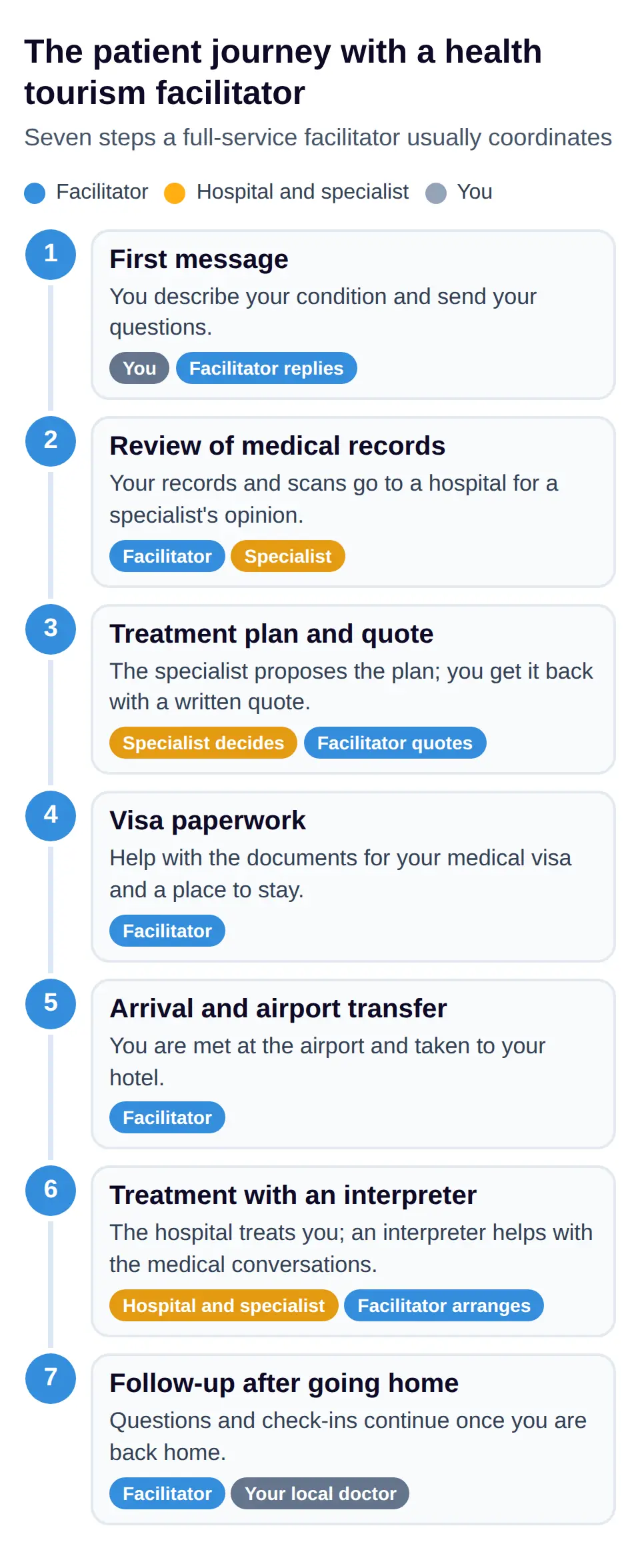
Think of a medical travel facilitator as the person between you and a hospital you have never seen. One study describes the role as a bridge linking patients with the hospitals and doctors who treat them. In practice that means a long list of small jobs you would otherwise do yourself, in another language and another time zone.
A full-service facilitator usually covers three stretches of the trip.
- Before you travel: collecting your medical records and scans, sending them to a hospital for a specialist’s opinion, passing back the treatment plan and a written quote, and helping with the visa paperwork and a place to stay.
- While you’re there: meeting you at the airport, getting you to appointments, arranging an interpreter for consultations, and being the person you call when something is unclear.
- After you go home: passing your questions to the doctor, sending your records, and keeping in touch during the first weeks of recovery.
How much of this a company actually does varies a lot. Some only book the hospital; others stay with you until well after the flight home. That difference is the first thing to pin down.
Facilitator, hospital department or online platform?
You can arrange treatment abroad in three ways, and the facilitator is only one of them. Many hospitals that treat foreign patients have an international patient department, a unit whose job is to arrange diagnosis and treatment for foreign patients. Online platforms, meanwhile, let you compare hospitals and send enquiries yourself.
| Directly with a hospital | Through a facilitator | Through an online platform | |
|---|---|---|---|
| Who you talk to | The hospital’s international patient department | One coordinator for the whole trip | The platform first, then each hospital |
| Who suggests the hospital and doctor | You choose; the hospital assigns a specialist | The facilitator proposes options from its partner hospitals | You compare and choose |
| Language help | Some hospitals provide it | Usually an interpreter is arranged | Usually up to you |
| Hotel, transfers, visa paperwork | Some hospitals help with part of it | Usually arranged for you | Mostly up to you |
| Who is responsible for your medical care | The hospital and the doctor | Still the hospital and the doctor | Still the hospital and the doctor |
| How the intermediary is paid | No one in between | Commission from the hospital, a fee from you, or both | Usually by the hospitals listed |
| Best for | Short, simple treatments and confident travellers | Complex treatment, longer stays, a language barrier | Patients who want to compare hospitals before deciding |
If you’re having a short, routine procedure and you’re comfortable organising travel, going direct can work well. For a transplant, major surgery or a stay of several weeks, it usually helps to have one person who holds all the pieces together.
How facilitators are paid
Facilitators earn money in two main ways. Many are paid a commission by the hospital, typically a set share of the hospital’s fees, paid once your treatment is done and the bill is settled. Others charge a fixed fee, paid either by you or by the provider.
The commission can be large. In one study of facilitation companies in London and Delhi, staff spoke of receiving 20 to 30% of what patients paid.
Neither model is wrong in itself, but it changes what you should ask. A facilitator paid by hospitals has a reason to send you to its partners, so ask how it is paid and whether its own share is already inside the price you’re quoted.
Advantages, drawbacks and limits
A good facilitator saves you a great deal of organising. A weak one adds a layer between you and your doctor. It helps to see both sides before you sign anything.
Advantages
- One contact person instead of a dozen.
- Help in a language you understand.
- Local knowledge of hospitals and specialists.
- Transfers, accommodation and other logistics handled for you.
Drawbacks
- One more party between you and the doctor.
- A possible pull towards the hospitals that pay the facilitator.
- Quality that differs widely from one company to the next.
What no facilitator can do
Your treatment is decided by the hospital and the specialist after they have seen your records, not by the coordinator. Nobody can guarantee a result, and facilitators interviewed in a 2011 study described their role as advocacy and information, limited by their legal liability. Treat any company that promises more with caution.
Standards and accreditation: what the logos mean
The closest thing to an international rulebook is ISO 22525:2020, a voluntary standard for medical tourism services that applies to facilitators as well as to hospitals. A company can work without it, so its absence alone tells you little.
Hospital accreditation is a separate matter. The US CDC names bodies such as Joint Commission International as groups with standards a hospital must meet to be accredited. Its advice to patients is simpler, and it applies whatever logos you see: check the qualifications of the clinician and the credentials of the facility yourself.
A badge on a facilitator’s website is a claim, not a licence. What counts is whether the company is allowed to work with foreign patients in the country where you’ll be treated.
How to check a health tourism facilitator’s licence in Iran
Iran licenses its facilitators. In 2019 the Ministry of Health and the national tourism organisation signed an agreement, and a regulation for licensing health tourism facilitator companies was published. One of its main aims, as reported at the time, was to stop unqualified people from working in the field illegally.
A Ministry of Health official said at the time that facilitators’ fitness to work with hospitals certified to admit foreign patients would be checked through the ministry’s licensing office. So two things matter to you: the facilitator’s licence and the hospital’s own certification.
Before you pay a medical tourism facilitator for treatment in Iran, ask for the name of its licence, the number and the body that issued it. Ask which hospitals it works with, and whether each one is certified to admit foreign patients and has an international patient department. Then contact the hospital yourself to confirm that it accepts patients through that company.
If you’re going elsewhere, every destination has its own rules, but the same questions work there too.
Questions to ask before you pay anything
Send these questions to any facilitator you’re considering, and get the answers in writing.
- Which licence do you hold, and who issued it?
- Which hospital and which specialist would treat me, and when can I speak to the doctor?
- What does the quote include, and what does it leave out?
- Can the price change after I arrive, and in which situations?
- How are you paid: by the hospital, by me, or both?
- Who do I call at night or in an emergency during my stay?
- If a complication comes up, during my stay or after I’m home, who looks after me?
- What follow-up do I get after I go home, for how long, and through which channel?
- Will I get my medical records in English before I leave?
Red flags
Some warning signs are easy to spot once you know them. Walk away, or at least slow down, if you see any of these.
- No licence shown, or a vague answer when you ask for it.
- A firm price before anyone has looked at your medical records.
- Pressure to pay a large deposit quickly.
- Promised results, or talk of treatment with no downside.
- No named hospital until after you’ve paid.
- No way to talk to the treating doctor before you travel.
After you fly home
The trip doesn’t end at the airport, and this is the part patients ask about least. The CDC advises getting copies of all your medical records from the hospital before you return home, so your own doctor can see exactly what was done.
It also warns that follow-up care for complications can be expensive and might not be covered by your health insurance. Before you travel, get in writing how long follow-up lasts and how you reach the team once you’re home.
How Medipars coordinates treatment in Iran
Medipars is an Iran medical tourism facilitator. Here is what it arranges and on what terms.
- One coordinator arranges the whole trip. The package covers accommodation, airport transfers, an English interpreter for medical purposes only, pre-op and post-op care, the operation and doctor visits.
- Some things are not included: the attendant’s visa, medication and international flights, which you buy yourself.
- The price is set for your own case in a personal quote, and once you have it, it stays fixed unless something exceptional happens, such as a cancelled flight.
- The first reply to your message comes in under 2 hours.
- Follow-up is free for 1 week after you return home, through a coordinator on WhatsApp, and you can still consult your doctor through Medipars after that.
- Treatment takes place at one of a fixed set of partner hospitals.
Medipars’s licence and the authorities named on it are on the About page.
For the most complex treatments, such as a kidney transplant in Iran, the coordinator’s role runs from the first review of your records to follow-up at home.
To see how such a package is laid out, read what a kidney transplant package includes.
If you’re planning treatment in Iran, send us your medical records and we’ll come back with a personal plan and quote for your case, so you can see what is included and what is not before you decide.
Questions patients ask about facilitators
You can arrange treatment yourself, especially for a short, simple procedure in a hospital with a good international patient department. In practice that means contacting that department yourself, sending your records and waiting for the treatment plan, then booking your own stay, airport transfers and interpreter. If you go that way, use the checklist above with the hospital directly.
Using a facilitator is only as sound as the company and the hospital behind it. Check the facilitator’s licence in the destination country, and check the qualifications of the doctor and the credentials of the hospital yourself. A good facilitator makes those checks easy rather than discouraging them.
A travel agent books flights and hotels. A facilitator works on the medical side of the trip. It sends your records to the hospital, passes back the specialist’s treatment plan and a quote, and arranges the interpreter, the stay around the treatment and the follow-up. A travel agent isn’t set up to answer medical questions or deal with a hospital on your behalf.
Yes. Help with the visa paperwork is usually part of what a full-service facilitator does. The documents you need depend on your nationality and your treatment, so ask your facilitator or the hospital’s international patient department exactly what they will prepare and what you must provide.
Sources (8)
- The 'patient's physician one-step removed': the evolving roles of medical tourism facilitators.
- Understanding the multidimensional role of medical travel facilitators: A study on competencies and a proposed model.
- Introduction | Public Relations
- Going for brokerage: strategies and strains in commercial healthcare facilitation – PMC
- | Standards Council of Canada
- Medical Tourism: Travel to Another Country for Medical Care | Travelers' Health | CDC
- ابلاغ آییننامه تاسیس و بهرهبرداری شرکتهای تسهیلگر حوزه گردشگری سلامت
- احراز صلاحیت شرکتهای تسهیلگر سلامت از طریق اداره صدور پروانه
